
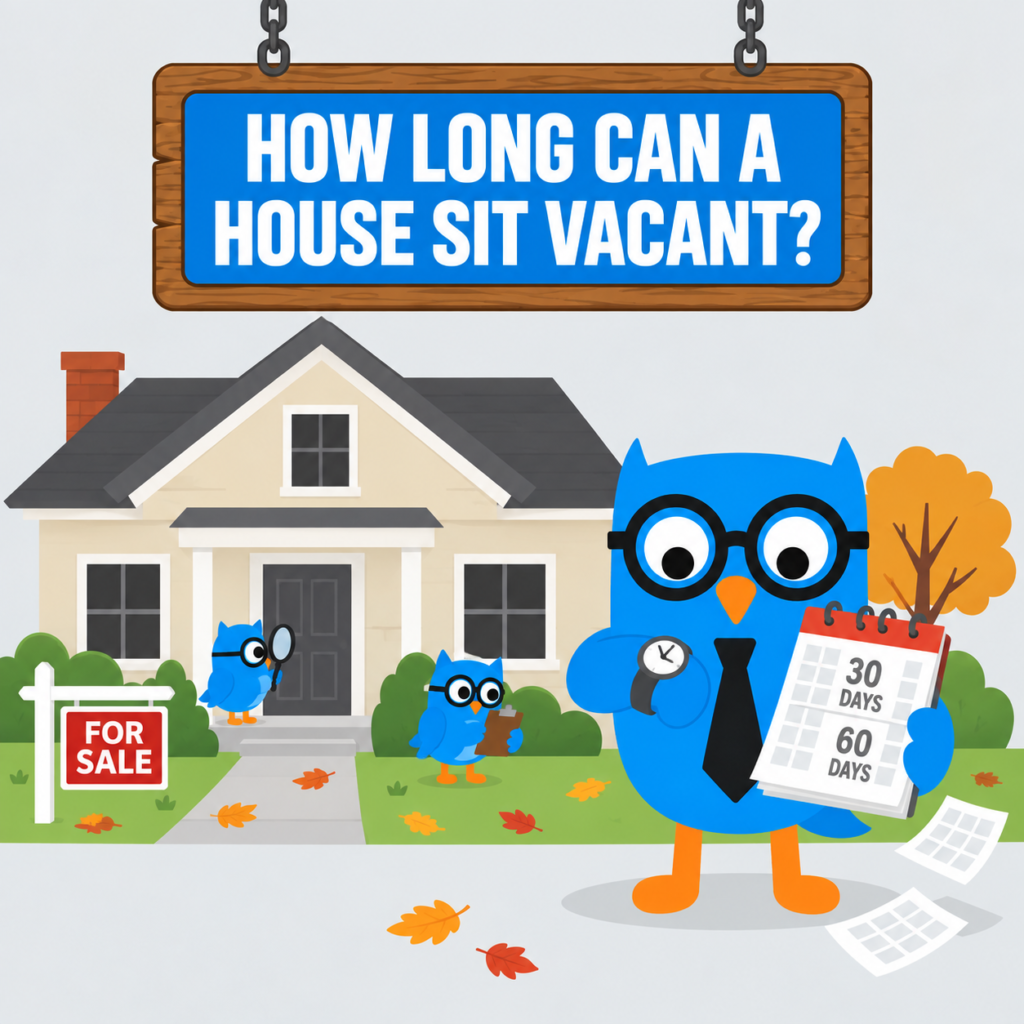
How Long Can a House Sit Vacant Before Insurance Becomes a Problem?
Mr. Hoots explains why the length of time a property sits empty can matter and why waiting too long to review your coverage could leave you with an unpleasant surprise.
Hoo’s there? Mr. Hoots here, checking the calendar while keeping watch over an empty house.
A few days without anyone home probably does not sound unusual. But what about 30 days? 60 days? Six months?
One of the most common questions property owners have is how long a house can sit vacant before it affects insurance. Unfortunately, there is no single number that applies to every property or every policy.
Here’s what you need to know before the calendar starts working against you.
Is there a standard vacancy time limit?
You may have heard that a home can sit vacant for 30 or 60 days before insurance becomes an issue.
Those timeframes can appear in insurance policies, but there is no universal rule that applies to every insurer or every situation.
Your policy may define vacancy differently and may change, restrict, or exclude certain coverage once specific conditions are met.
Hoot tip: Do not rely on a number you heard from a friend, neighbor, or online. Check the actual policy covering your property.
Why does time matter when a house is vacant?
The longer nobody is regularly at a property, the greater the opportunity for something to happen without being noticed.
Think about a small plumbing leak.
In an occupied house, someone might discover it that morning. In a vacant property, it could continue until the next inspection.
The same problem applies to broken windows, roof damage, vandalism, unauthorized entry, and other issues.
The longer a property sits unattended, the more time a small problem has to become a large one.
What happens to homeowners insurance when you move out?
Moving out does not necessarily mean your homeowners policy immediately disappears.
But it does mean something important has changed.
Homeowners insurance is generally written with the expectation that the insured home is being used as a residence. Once you move out permanently and the property sits vacant, the risk may no longer match what the policy was originally designed to cover.
That is why notifying your insurance professional about a change in occupancy is important.
What if the house is waiting to sell?
This happens all the time.
You buy another home, move everything out, and put the old house on the market.
The property might sell next week, or it might sit for several months.
Even though you still own and maintain the house, it may now meet your insurer’s definition of vacant. The fact that it is actively listed for sale does not automatically prevent vacancy provisions from applying.
If you move out before closing, review the insurance situation rather than assuming the existing policy will continue unchanged until the buyer gets the keys.
What about a rental between tenants?
A short gap between tenants is normal for landlords.
But a rental sitting empty for an extended period can create a different insurance situation.
Maybe you’re making repairs. Maybe the next tenant fell through. Maybe you’re waiting for the rental market to improve.
Whatever the reason, check how your existing landlord or rental-property policy handles extended vacancy.
A two-week turnover and a property sitting empty for six months are very different exposures.
What if I’m renovating the property?
Renovations add another layer.
A property can be vacant while construction or renovation work is happening, but the type and extent of that work can affect what insurance is appropriate.
Replacing flooring and painting walls is different from removing a roof, gutting the interior, or making structural changes.
Depending on the project, vacant property coverage alone may not address every construction-related exposure.
Mr. Hoots says: Before the first hammer swings, make sure your insurer knows what is actually happening at the property.
Don’t wait for the vacancy deadline
One of the biggest mistakes is thinking:
“I’ll deal with the insurance when I hit 30 or 60 days.”
The better time to review coverage is when you know the property’s occupancy is changing.
That could be:
- When the last tenant moves out
- When you move into your new home
- When you inherit an empty property
- When you purchase an investment property that will initially sit vacant
- Before renovations begin
- When a property is going on the market without anyone living there
Waiting for an arbitrary deadline can create unnecessary uncertainty.
Protect the property while it sits
The insurance policy is only one part of protecting a vacant property.
Regular inspections matter too. Keep the exterior maintained, secure doors and windows, remove mail and packages, address maintenance problems quickly, and consider security cameras, alarms, or other monitoring appropriate for the property.
If nobody is living there, somebody should still be checking on it.
Mr. Hoots’ Bottom Line
There is no universal number of days that makes every home “vacant” for insurance purposes.
The policy language, condition of the property, reason for vacancy, length of vacancy, and what is happening at the property can all matter.
If you know a home is going to sit empty, do not start counting days and hope for the best. Review the coverage when the situation changes.
Protect the Property. Protect the Investment. Because the calendar should never be the reason you discover a coverage problem too late.
-Mr. Hoots
Share this post.
Know someone whose house is sitting empty while they sell, renovate, or wait for a new tenant? Send this their way.
Need vacant property coverage?
My Vacant Guard makes it easy to get a quote for an eligible vacant property online, without the traditional back-and-forth.